Walk Your Event Before Your Visitors Do: The Complete Event Marshal Checklist A working checklist…
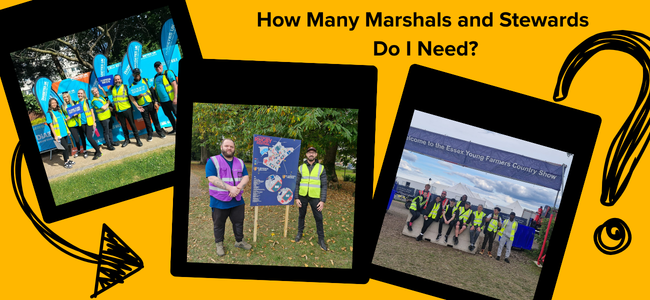
How Many Marshals and Stewards Do I Need for My Event?
How Many Marshals and Stewards Do I Need for My Event?
Preview: How many marshals and stewards does an event actually need? There is no single number that works for every event because attendance is only one part of the calculation. Venue layout, audience profile, entrances and exits, activities, crowd movement, transport arrangements and identified risks can all influence the level of stewarding required. This guide explains the factors organisers should consider when planning their event team and why the right question is not simply how many people are attending, but what those people will be doing throughout the event.
How Many Marshals and Stewards Does an Event Need?
It is understandable that event organisers want a straightforward answer when deciding how many marshals and stewards they require. Once the expected attendance is known, it can be tempting to look for a standard ratio that converts visitor numbers into a staffing requirement.
In practice, events do not work that way.
Two events attracting the same number of people can create completely different operational demands. A daytime community event spread across a large open park has little in common with an evening concert held within a confined town-centre space, even if attendance is identical. The way people arrive, where they gather, how they move around the site and how quickly they leave can all affect the stewarding requirement.
For this reason, the number of marshals and stewards should be considered as part of the wider event planning and risk assessment process. Rather than starting with a ratio, organisers need to consider what needs to happen on the ground and where staff will be required to support it.
Expected Attendance Is Only the Starting Point
Visitor numbers clearly matter because an event expecting significant footfall will usually create more crowd management requirements than a very small gathering. However, attendance should be treated as the beginning of the discussion rather than the complete answer.
The more useful questions concern how those attendees will behave within the event environment. Will everybody arrive within a short window or will arrivals be spread throughout the day? Will visitors remain in one area or move constantly between attractions? Are there performances that could cause large groups to move simultaneously? Will the audience leave gradually or is there likely to be a significant departure immediately after the event finishes?
These patterns can be more important than the headline attendance figure.
A festival, for example, may have visitors circulating continually between stages, food areas, bars and facilities. A sporting event might have a much more concentrated arrival followed by a substantial movement towards exits when the fixture ends. A Christmas market could experience relatively gentle weekday footfall followed by intense periods during evenings and weekends.
Understanding these patterns helps organisers identify where marshals and stewards are actually required rather than simply calculating a total number and distributing people evenly around the venue.
Venue Layout Can Change Stewarding Requirements
The physical environment is one of the biggest factors affecting how many event marshals and stewards may be needed.
Large open spaces can provide plenty of room for people to circulate, while venues containing narrow walkways, multiple levels, temporary structures or restricted entrances can create very different challenges. Even an event with modest attendance can require careful stewarding when visitors have to move through confined areas.
Entrances and exits deserve particular attention because these are locations where people naturally converge. An event with several well-spaced entrances may distribute arrivals effectively, while a venue relying on one main entrance can create a concentrated period of activity requiring more active management.
The same principle applies throughout the site. Bridges, staircases, pedestrian crossings, temporary barriers, stage approaches and narrow pathways can all become points where crowd movement needs observation and guidance.
This is why reviewing the event site as a series of individual operational areas can be more useful than looking at the venue as a whole. Each location has a purpose, expected level of activity and potential challenges, and those factors help determine whether a marshal or steward position is necessary.
Entrances, Exits and Queues Need Their Own Consideration
An entrance is rarely just a doorway through which visitors walk. Depending on the event, people may need to locate the correct gate, present tickets, collect wristbands, undergo security procedures or wait for a particular admission time.
Each additional process affects how quickly people can enter and how queues develop.
Marshals and stewards can support these areas by providing information, guiding people towards the correct location and helping maintain an organised flow. The staffing requirement will therefore depend partly on the complexity of the arrival process rather than simply the number of attendees.
Queues elsewhere at the event also need consideration. Food outlets, toilets, attractions, registration points and transport facilities can generate substantial lines at busy periods. When queues begin extending into pedestrian routes or neighbouring operational areas, they can affect the movement of people who are not actually using that facility.
Planning stewarding around these areas means thinking about where queues are likely to form, how large they could become and what other parts of the event might be affected when demand reaches its peak.
Audience Profile Influences Event Stewarding
Who is attending can be just as relevant as how many people are attending.
A family event with young children and pushchairs creates different movement patterns from a late-night music event. A sporting fixture has its own spectator behaviours, while an event attracting large numbers of older visitors may require additional consideration around accessibility, seating and movement between different areas.
Alcohol can also change the operational picture. Events where alcohol is available may experience different crowd behaviour as the day progresses, particularly around bars, entertainment areas and exits. This does not automatically mean that general stewards should undertake security duties, but it can influence how the overall event team is structured and where different types of personnel are positioned.
Organisers should therefore think about the audience they realistically expect rather than treating every visitor as an identical unit within a staffing calculation. Understanding the audience helps anticipate the questions they may ask, the areas they are likely to use most heavily and the type of support they could require.
Crowd Movement Matters More Than Crowd Size Alone
Crowd management is often discussed in terms of density, but movement is equally important.
People rarely remain evenly spread across an event site. A particular performance, announcement, weather change or transport deadline can cause hundreds of people to move at once. A location that has been quiet for most of the day can suddenly become one of the busiest areas on the site.
Experienced event planning considers these changes in advance.
At a festival, the end of a popular performance can generate movement towards another stage. At a race or sporting event, spectators might gather around the start or finish before moving towards car parks and public transport. At an outdoor event, sudden heavy rain can cause large numbers of visitors to head towards covered areas simultaneously.
Marshals and stewards positioned with these movements in mind can help provide directions, monitor conditions and report developing congestion. This is considerably more effective than placing staff at convenient locations and assuming the crowd will behave as expected throughout the day.
Car Parks and Transport Areas Should Not Be Forgotten
The visitor experience often begins before somebody reaches the event entrance.
Car parks, pedestrian routes, drop-off areas and transport points can require significant organisation, particularly when large numbers of vehicles and pedestrians arrive together. An event may appear straightforward inside the venue while presenting a completely different set of challenges around its perimeter.
Car park marshals can help direct vehicles towards appropriate areas and support pedestrian movement where this falls within the agreed traffic management arrangements. Other staff may be positioned along walking routes between transport points and entrances so visitors know where they are going.
Departure planning is equally important. When an event finishes, visitors may head towards vehicles, taxis, buses and railway stations within a relatively short period. This concentrated movement should form part of the stewarding discussion rather than being treated as something that happens after the event itself has ended.
Emergency Arrangements Affect Marshal and Steward Positions
Event staffing also needs to reflect the procedures that would be followed if normal operations were interrupted.
Emergency routes need to remain accessible; important exits may require monitoring and specific positions may form part of an evacuation or incident response plan. The role of marshals and stewards within those arrangements should be clearly defined before visitors arrive.
This does not mean that general event marshals replace medical personnel, licensed security staff or emergency services. Their purpose is to perform the duties allocated to them within the wider event safety structure.
When considering staffing requirements, organisers should therefore ask whether important locations need dedicated coverage and what would happen to those positions if an incident occurred elsewhere. A staffing plan that works perfectly during normal operations should also be capable of supporting the event’s agreed contingency arrangements.
Consider What Each Marshal or Steward Will Actually Do
One of the most useful ways to approach stewarding numbers is to stop thinking about the total number of staff temporarily and instead consider individual positions.
What needs to happen at the main entrance? Who is supporting the secondary entrance? Does a busy pedestrian junction require somebody throughout the event? Who is providing directions between the car park and venue? Which areas need observation during peak crowd movements? Are there positions that only become necessary at particular times?
Once those responsibilities have been identified, the overall staffing requirement becomes much clearer.
This approach also prevents a common planning problem where plenty of staff appear to have been allocated on paper, but important areas remain uncovered because nobody has been assigned a specific responsibility.
A good deployment plan should give each marshal or steward a clear purpose rather than simply creating a headcount.
Staff Breaks and Shift Lengths Need to Be Part of the Plan
An event may have identified all the correct positions and still experience gaps if breaks, shift changes and welfare arrangements have not been considered.
Marshals and stewards cannot simply remain in the same position indefinitely, particularly during long outdoor events where weather conditions may also affect welfare requirements. If a position needs continuous coverage, somebody needs to take over while the original member of staff has a break.
This becomes increasingly important for events running over long hours or several days. Staffing should therefore consider not only the number of operational positions but also how those positions will remain properly covered throughout the required period.
It is a practical detail, but one that can make a significant difference between a staffing plan that looks adequate on paper and one that actually works throughout the event.
Why There Is No Universal Event Stewarding Ratio
Searching online for an event steward ratio can produce apparently simple answers, but applying a generic number without considering the event itself can create a false sense of certainty.
A staffing level that works for one venue, audience or activity may be inappropriate for another. Risk assessments, venue requirements, event plans, licensing considerations and relevant guidance may all influence what is required in a particular situation.
Rather than asking, “How many attendees can one steward manage?”, it is often more useful to ask, “What needs to be managed at this event?”
That change in perspective moves the discussion away from arbitrary numbers and towards the actual operational requirements of the day.
Planning the Right Number of Marshals and Stewards for Your Event
Determining how many marshals and stewards an event needs is ultimately about understanding how the event will work when real people arrive.
Attendance figures provide useful context, but they do not reveal where visitors will gather, when queues will form, how people will move between areas or which locations will become busiest at particular times. Those answers come from looking at the venue, programme, audience, transport arrangements, identified risks and expected crowd behaviour together.
For organisers, the most useful starting point is therefore to map the event from arrival through to departure and consider what needs to happen at each stage. Entrances, exits, queues, pedestrian routes, attractions, transport areas and contingency arrangements can then be reviewed individually, with marshal and steward positions linked to genuine responsibilities.
There may never be one simple formula for calculating the correct number of event marshals and stewards, and that is precisely because no two events operate in exactly the same way. A considered, event-specific approach produces a much more meaningful staffing plan than relying on a number based on attendance alone.

Related Posts